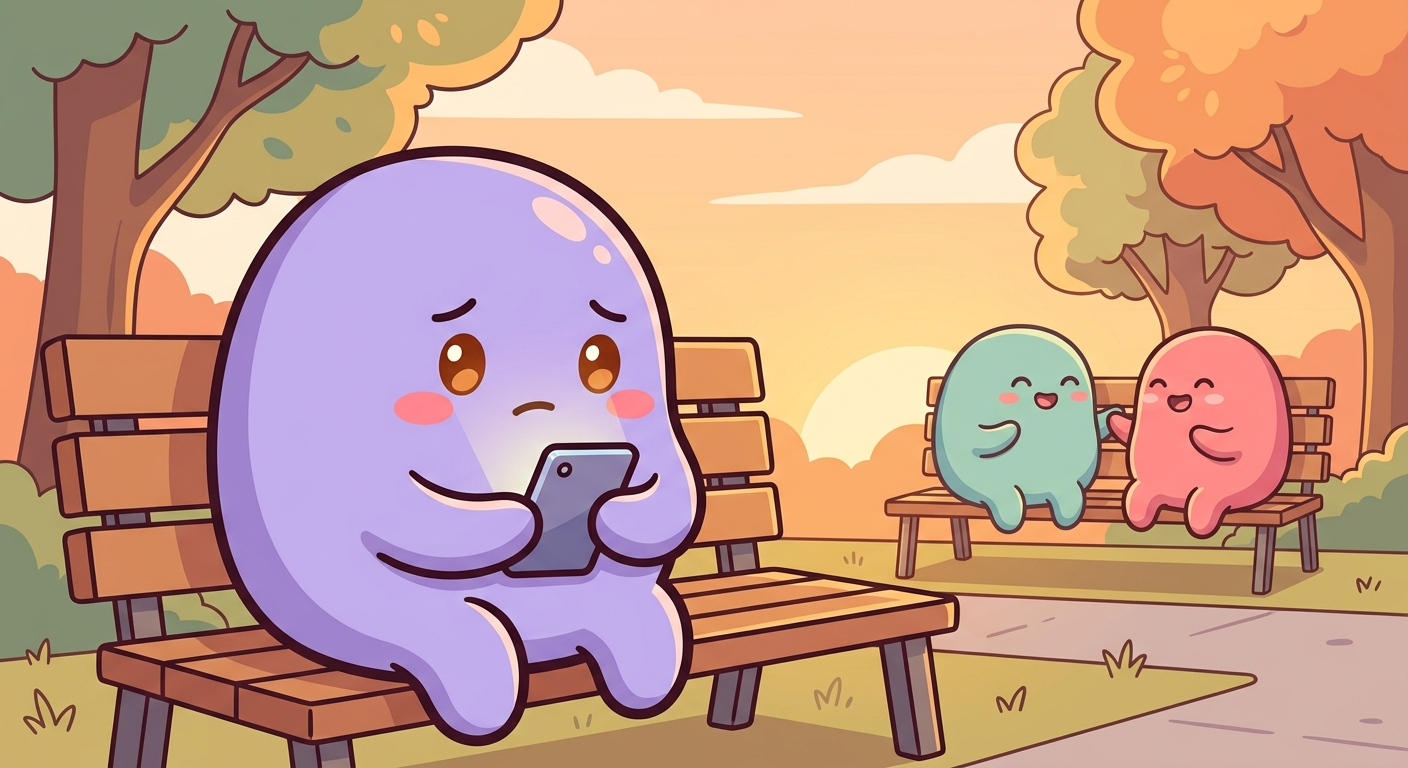
If you’ve noticed that talking to people in person feels harder than it used to — more draining, more awkward, more like a skill you’re losing — you’re not imagining it.
The data says you’re right.
The numbers
People aged 15–24 spend 70% less time in person with friends than those of the same age in 2003. That’s not a slow drift — researchers describe the drop as “a Black Diamond ski slope straight down,” beginning around 2010.
And it’s not just the young. A Forbes Health Survey found 59% of all respondents said forming relationships has been harder since the pandemic. The Surgeon General declared loneliness a public health epidemic in 2023, calling it as dangerous as smoking 15 cigarettes a day.
Something has shifted for everyone. But what?
We got fluent in the wrong medium
Most of us can text for hours. We can write thoughtful emails, craft messages, edit before sending. We’re fluent in asynchronous, editable communication.
But conversation isn’t editable. It’s live. You can’t draft a reply, re-read it, and hit send. You have to think and speak simultaneously, under social pressure, with no backspace key.
That gap — between how comfortable we are communicating through screens and how comfortable we are communicating through our voices — has been quietly widening for years.
75% of young adults now report anxiety about voice calls. The word for it is telephobia, and it didn’t exist a decade ago.
Colleges in the UK are now offering courses on how to phone a restaurant.
It’s not that people have lost intelligence or emotional depth. It’s that they’ve had less practice with the hardest version of communication: unrehearsed, real-time, face-to-face.
The liking gap (you’re better than you think)
Here’s the thing that makes this worse: we’re not just struggling — we think we’re struggling more than we are.
Psychologists at Yale discovered what they call the “liking gap.” After a conversation with a stranger, people consistently underestimate how much the other person liked them and enjoyed talking to them. And this isn’t a small effect — it persists even as relationships develop over months.
So you walk away from a conversation thinking that was awkward, they probably thought I was weird, and they walk away thinking that was nice, I liked them.
Your internal scorecard is broken. It’s systematically too harsh. Knowing this won’t fix the anxiety, but it reframes it: the problem isn’t that you’re bad at conversation. It’s that you think you’re bad at conversation.
The parasocial trap
There’s another dynamic worth naming. Many of us now spend hours each day in one-sided relationships — with streamers, podcasters, influencers, YouTubers. These feel like social connections. Your brain processes them similarly. But they’re parasocial: you’re giving attention without receiving any.
Research published in 2025 found that stronger parasocial relationships predict higher loneliness, not lower. The illusion of connection substitutes for the real thing, and real relationships — which require patience, awkwardness, and reciprocity — start to feel deficient by comparison.
The fix isn’t to stop watching content. It’s to notice when consumption is replacing conversation, and to deliberately add real interactions back in.
”Social battery” isn’t always self-care
There’s a popular idea that social interaction drains a battery, and that protecting your battery is self-care. For genuine introverts, there’s truth in this.
But for many people, “my social battery is dead” has become a socially acceptable way to say “I’m avoiding something that makes me anxious.” And avoidance — while it feels like relief in the moment — makes the anxiety worse over time. The less you practice, the harder it gets. The harder it gets, the less you practice.
The awkwardness isn’t a sign that something is wrong. It’s the feeling of a skill being rebuilt.
The clinical term is graduated exposure: the most effective treatment for social anxiety is doing the thing that makes you anxious, in manageable doses, repeatedly. Not thinking about it. Not reading about it. Doing it.
What actually helps
The research converges on a few things:
1. Practice with your voice, not your thumbs
Text can’t train conversation. The freeze happens in the gap between thinking and speaking — a gap that only exists when you’re actually speaking. Any practice that involves your voice is more effective than any amount of reading or texting.
2. Start stupidly small
The best interventions aren’t “go talk to 10 strangers.” They’re: ask the barista one genuine follow-up question. Give a colleague a specific compliment. Say hello to someone you normally pass in silence. The compound effect of tiny, repeated actions is how confidence actually builds.
3. Know your scores are wrong
Remember the liking gap. You almost certainly came across better than you felt. The internal cringe after a conversation is not data — it’s anxiety talking. Other people are more forgiving, more interested, and more warm than your brain assumes.
4. Strangers want to talk to you
University of Chicago researchers told commuters to start conversations with strangers. Everyone predicted it would be awkward. The actual rejection rate was close to zero. Both sides reported more positive experiences than those who sat in silence. The barrier is in your head, not in theirs.
5. Follow-up questions are magic
Harvard research found that people who ask follow-up questions — building on what the other person just said — are rated significantly more likeable. Not because they’re clever or funny, but because they showed they actually listened. One good follow-up question is worth more than ten interesting things to say.
6. Warmth beats impressiveness
People judge your warmth before your competence, and warmth matters more. Roughly 80% of first impressions come down to two things: do I feel warm towards this person, and do they seem capable? Trying to seem impressive too early backfires. Lead with genuine interest. The impressive stuff can wait.
The skill that’s worth rebuilding
Conversation is a skill. It atrophies without practice and comes back with it. That’s not a judgement — it’s how skills work.
The world shifted under everyone’s feet. Screens got better, real-life practice got rarer, and the muscle weakened. But it’s still a muscle. And muscles respond to training — even a few minutes at a time, even when it feels awkward, even when you’re out of practice.
The people who are good at conversation aren’t the ones who never felt anxious about it. They’re the ones who kept practising anyway.
Sation is a small-talk practice app. Short voice chats with AI characters who came to that coffee shop for their own reasons, then an honest read on how the conversation actually landed — plus one tiny real-world challenge to try in your day. See how it works.
Sources
- Epley & Schroeder, “Mistakenly Seeking Solitude,” Journal of Experimental Psychology, 2014
- Boothby, Cooney & Sandstrom, “The Liking Gap,” Psychological Science, 2018
- Huang, Yeomans, Brooks, Minson & Gino, “It Doesn’t Hurt to Ask,” Journal of Personality and Social Psychology, 2017
- Cuddy, Fiske & Glick, “Warmth and Competence,” Trends in Cognitive Sciences, 2008
- Kardas, Kumar & Epley, “Overly Shallow?,” Journal of Personality and Social Psychology, 2022
- U.S. Surgeon General’s Advisory on Social Connection, 2023
- McKinsey Health Institute, “Gen Z Mental Health,” 2024
- Lamash, “Social Interaction Skills on Social Media vs. In Person,” Journal of Adolescence, 2024
- Springer Nature, “Parasocial Relationships and Loneliness,” 2025